
I often face the same choice at airport fences or hotel balconies. Should I grab a spotting scope vs binoculars for the best views of incoming jets? Both tools help me catch tail numbers and liveries from afar. Binoculars win for quick scans, while scopes shine for locked-in details.
Plane spotting demands clear optics in bright light or dusk. I have tested dozens on spotting trips. This guide breaks down the differences so you pick right.
Last verified August 2026.
How Spotting Scopes Work for Aviation Fans
Spotting scopes pack high magnification, often 20x to 60x. They mount on tripods for steady views. I love them for distant runways where planes look like dots without help.
These scopes narrow the field of view. That trade-off brings sharp images of cockpits and engines. However, they weigh more and need setup time.
In plane spotting, scopes excel from fixed spots. Think hotel rooms with runway sightlines. I stay at spots like those listed on plane spotter hotels for such views.
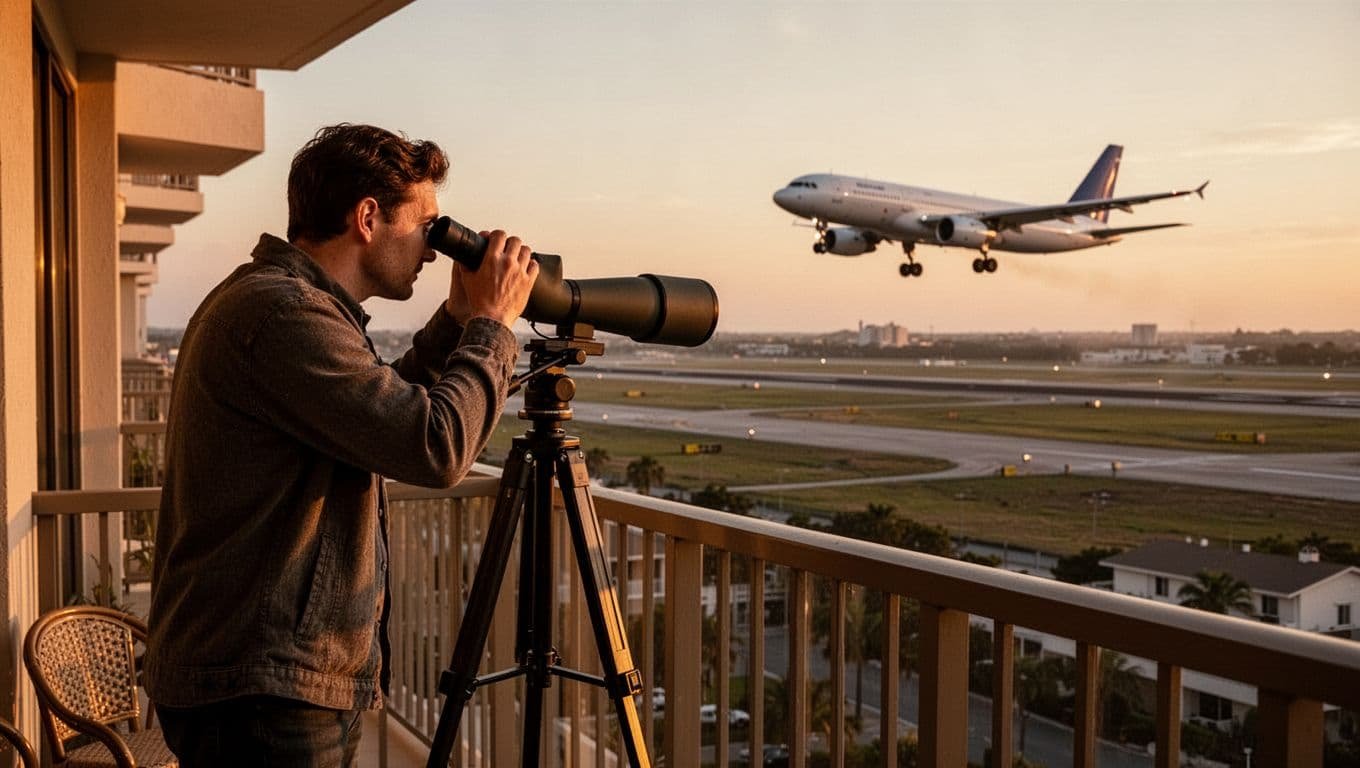
A spotter on a balcony locks onto a landing jet with a scope. Dusk light tests clarity.
Scopes handle heat haze better at midday. For example, I zoom on a 787’s winglets two miles out. Still, panning for fast taxiing aircraft feels clunky.
Where a scope genuinely wins
The gap between a scope and binoculars is biggest at long range and in poor light. Once an aircraft is more than a mile or so out, binoculars start to lose the fine detail that makes an identification satisfying — the registration blurs into a smudge, and liveries turn into blocks of color rather than recognizable branding. A scope at 30-40x keeps that detail readable, which matters if you’re logging registrations or chasing a specific rare visitor rather than just watching the show.
The trade-off is time. Every scope session involves setup: extending the tripod, leveling it, attaching the head, and getting the eyepiece angle right before I even start scanning. For a two-hour stint at a fixed spot that’s a non-issue. For a spotter who’s moving between three or four vantage points in an afternoon, that setup time adds up fast and starts to eat into actual spotting time.
Binoculars: Your Go-To for Airport Action
Binoculars offer two eyepieces for both eyes. Magnification runs 8x to 15x typically. They stay handheld, so I swing them fast between gates.
Wide fields of view help track flights across the sky. Comfort matters during long sessions. I pick waterproof models with good eye relief for glasses wearers.
For aviation buffs, binoculars suit observation decks. They balance power and portability. In contrast, scopes demand a stable base.
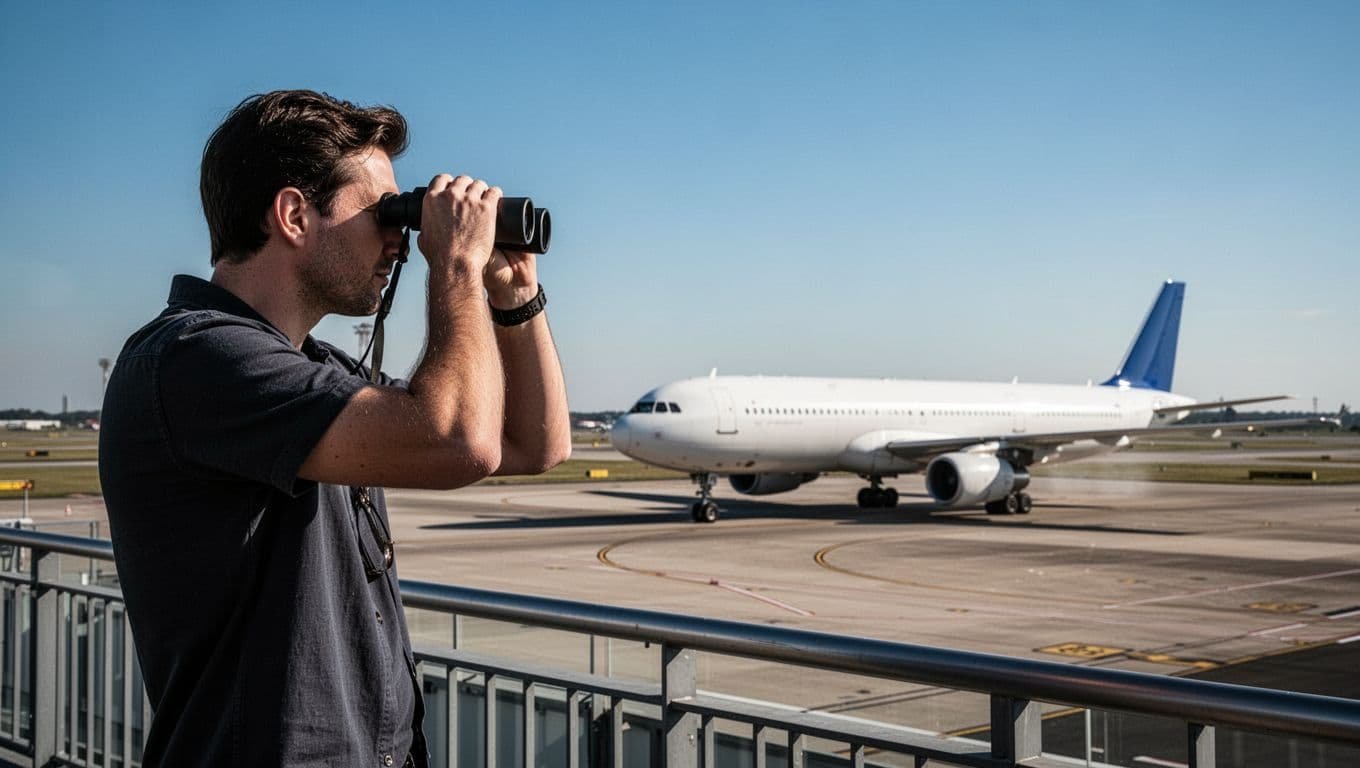
Spotter tracks a 747 with binoculars from a deck. Blue skies highlight easy handling.
I check guides like best binoculars for plane spotting for top picks. Models around 10×42 suit most spots.
Why binoculars still get the most use in my kit
Even though a scope pulls in more detail, binoculars are what I actually reach for on a typical spotting day. Two-eyed viewing is simply easier on the body over hours — no monocular eye strain, no hunched neck angle, and a much faster reaction time when an unexpected departure catches me off guard. If I hear an engine spool up somewhere off to the side, I can have binoculars up and tracking within a second. A scope on a tripod can’t match that.
Weight is the other factor. A good 10×42 pair sits comfortably around my neck for a full day at the fence without the shoulder fatigue a scope-and-tripod combination brings after a few hours of carrying it between spots.
Spotting Scope vs Binoculars: Direct Comparison
Both serve plane spotters, but match them to needs. Scopes dig deeper; binoculars cover broader scenes.
| Feature | Spotting Scope | Binoculars |
|---|---|---|
| Magnification | 20x-60x | 7x-15x |
| Field of View | Narrow (1-3 degrees) | Wide (6-8 degrees) |
| Portability | Tripod needed, bulky | Handheld, compact |
| Best Use | Fixed, distant detail | Scanning, mobile spotting |
| Price Range | $300-$1500 | $100-$600 |
| Weight | 2-5 lbs | 1-2 lbs |
This table sums my field tests. Scopes reveal serial numbers; binoculars spot arrivals first.
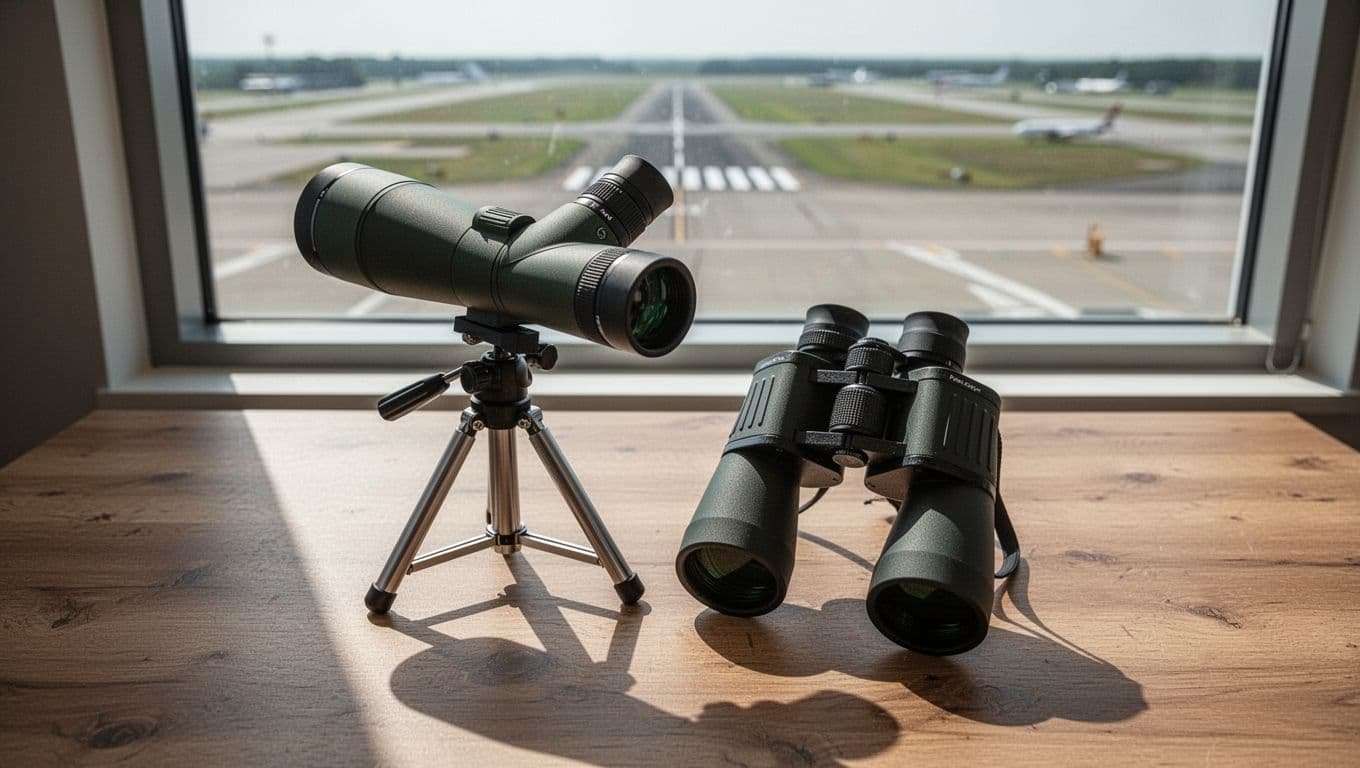
Side-by-side optics setup with airport view. Note the scope’s tripod base.
For deeper dives, see this spotting scope vs binoculars guide. It matches my experiences.
What I look for beyond magnification
Coatings matter more than most spotters realize when they’re comparing specs on a store shelf. Fully multi-coated optics — where every glass surface gets an anti-reflective treatment, not just the outer lenses — noticeably improve brightness and contrast, especially when I’m shooting into low sun during golden-hour arrivals. It’s the difference between a hazy, washed-out image and one with real color and edge definition on the fuselage.
I also pay attention to close focus distance, which sounds irrelevant for aircraft spotting until I’m at a smaller regional field where taxiways run close to the perimeter fence. A pair that only focuses down to 20 feet is useless for a taxiing aircraft passing within 50 feet of where I’m standing, so I check that spec even on binoculars I’ll mostly use for distant traffic.
Picking Winners for Plane Spotting Scenarios
Choose binoculars for busy airports. They track pushbacks and takeoffs smoothly. I use them at LAX or Heathrow decks.
Scopes fit static posts. From plane spotter hotels, I mount them for hours on finals. Heat shimmer fades at high power.
Mix both if budget allows. Start with binoculars, add a scope later. Common mistake: buying max zoom without testing eye strain.
Mobile spotting favors 10x binoculars. Hotel stays lean toward scopes. Always check exit pupils for low light.
A scenario-by-scenario breakdown
Airshow or open-day spotting, where aircraft move fast and unpredictably across a wide arc of sky, is a binoculars job every time — I need to reacquire a subject quickly and a scope’s narrow field makes that frustrating. Fence-line spotting at a busy hub during peak arrival banks is similar; there’s too much simultaneous traffic to justify locking a scope onto a single aircraft when three others are worth watching at once.
A quiet regional airport with infrequent movements flips that logic. I know roughly when the next arrival is due, I have time to set up, and the extra reach of a scope pays off on aircraft that might otherwise be too far out to identify with confidence. Long-haul hotel stays fall into the same category — I’m not moving around, so the setup cost of a scope is paid once and then forgotten for the rest of the session.
What I Wish I’d Known Before Buying My First Pair
My first binoculars were a cheap 20×50 pair, bought on the theory that more magnification meant a better view. It was the wrong call. At 20x, handheld shake becomes impossible to control — the image jumps around too much to actually identify anything, and I ended up straining to hold them steady rather than enjoying the spotting. I now stick to 8x or 10x for anything handheld, and save the higher magnification for a scope on a tripod where stability isn’t a problem.
The other lesson was about field of view. A narrow field sounds like a minor spec until you’re trying to find a small aircraft against a huge expanse of sky — a wider field of view means less time spent hunting and more time spent actually watching. I now check the degrees-of-view figure before magnification when I’m choosing binoculars for general airport use, and only prioritize raw power when I know I’ll be working from one fixed, planned position.
Real Tips from My Airport Stays
Pack roof-prism binoculars for travel. They fold flat in carry-ons. For scopes, carbon tripods cut weight.
Test in stores first. Eye relief matters if you wear specs. I avoid zoom models; fixed power stays sharper.
Budget $200 for solid binoculars. Spend more on scopes for digiscoping photos. Weather seals prevent fog on rainy days.
Quick win: Pair optics with apps for flight data. Spot faster that way.
Final Thoughts on Your Next Spot
Spotting scope vs binoculars boils down to your style. I grab binoculars for action, scopes for study. Both elevate spotting from good hotels.
What fits your next trip? Test one soon and log those registrations.
FAQ
Can binoculars replace a spotting scope for plane spotting?
No, binoculars scan well but lack scope detail for far tails. Use both for full coverage.
What’s the best magnification for airport viewing?
Aim for 10x in binoculars. Scopes at 30x work from fixed hotel spots.
Are expensive optics worth it for casual spotters?
Yes, if you spot often. Clarity beats cheap glass in glare.
How do I steady a spotting scope without a tripod?
You can’t reliably. Always pack one for shake-free views.
Which lasts longer in bad weather?
Waterproof models from both. Check IPX ratings before buying.
Can I use both a scope and binoculars in the same session?
I do this constantly. Binoculars stay around my neck for scanning and quick acquisitions, and the scope sits on its tripod nearby for anything worth a closer look once I’ve spotted it. The combination covers nearly every situation I run into.
Pingback: Best Spotting Telescope for Plane Spotting 2026, Our Picks
Pingback: Philadelphia Airport Hotels, Best Plane Spotter Hotels at PHL 2026