
Yes, How to Book a Hotel Room With a Runway View is possible, but it usually takes more than picking an airport hotel online and hoping for the best. If we want a true runway-view room, we need to choose the right airport, match it with a hotel that has proven sightlines, and confirm the exact room before we arrive.
That matters because many so-called airport-view rooms face terminals, roads, parking lots, or distant taxiways instead of active runways. For aviation fans and plane spotters, that can mean missing the whole point, whether we want to watch traffic, unwind with a great view, or take clean photos from the room. Recent spotter favorites like the TWA Hotel at JFK, the Renaissance Concourse at ATL, the Grand Hyatt at SFO, and the Westin at DTW show that the best results come from careful planning, not luck.
So instead of guessing, we’ll use a simple step-by-step process to narrow the airport, pick the right hotel, request the right room type, and confirm the view before check-in.
Hotel details, ratings and distances last checked August 2026. See our review process for how we verify each listing.
Start with the right airport and the right kind of hotel
If we want to learn How to Book a Hotel Room With a Runway View, the first real decision is not the room, it’s the airport. A great runway-view stay starts with traffic worth watching, then a hotel that sits in the right place to see it. Get those two choices right, and everything else gets easier.
Some airports look promising on paper but feel flat from the room. Others deliver constant movement, varied aircraft, and approaches that keep us at the window for hours. That difference is why we always build our shortlist from the airport outward, not the hotel inward.
Choose airports where runway action is worth the stay
Not all runway views are equal. Some are calm and scenic. Others feel like sitting beside a living machine, with departures rolling, arrivals dropping in, and heavies mixing with narrowbodies all day.
Three things shape the experience most:
- Flight volume decides how often something happens.
- Runway layout affects how much action we can actually see from one side.
- Aircraft variety changes how interesting the view feels over a full stay.
In 2026, a few U.S. airports stand out for aviation fans. Miami, JFK, DFW, LAX, and O’Hare are especially strong picks because they combine busy traffic with better spotting interest. Current flight and spotting data puts Miami near the top overall, while O’Hare stands out for sheer movement, with a huge daily flow of operations. DFW stays attractive because its runway layout can show multiple streams of action at once, and JFK keeps its edge with long-haul variety and recognizable widebody traffic.
That means we should match the airport to the kind of view we actually want. If we love widebody international traffic, JFK and Miami are hard to beat. If we want constant domestic movement, O’Hare and DFW usually give us more non-stop action. If famous approaches matter most, LAX has obvious appeal because arrivals are part of the draw, not just the airport itself. For a broader look at top airport hotel picks, this airport hotel roundup is a useful starting point.
A runway-view room is only exciting when the airport outside the glass gives us something worth watching.
We should also think about pace. Some of us want a slow evening with a few photogenic heavies. Others want the window to feel like a live feed. Picking the airport first helps us avoid paying extra for a view that turns quiet when we hoped for movement.
Look for hotels that are close enough, and on the correct side
Once we pick the airport, distance alone won’t save us. A hotel can sit right next to the field and still give us a weak view if it faces the wrong way. That’s why we always check the map before we ever check rates.
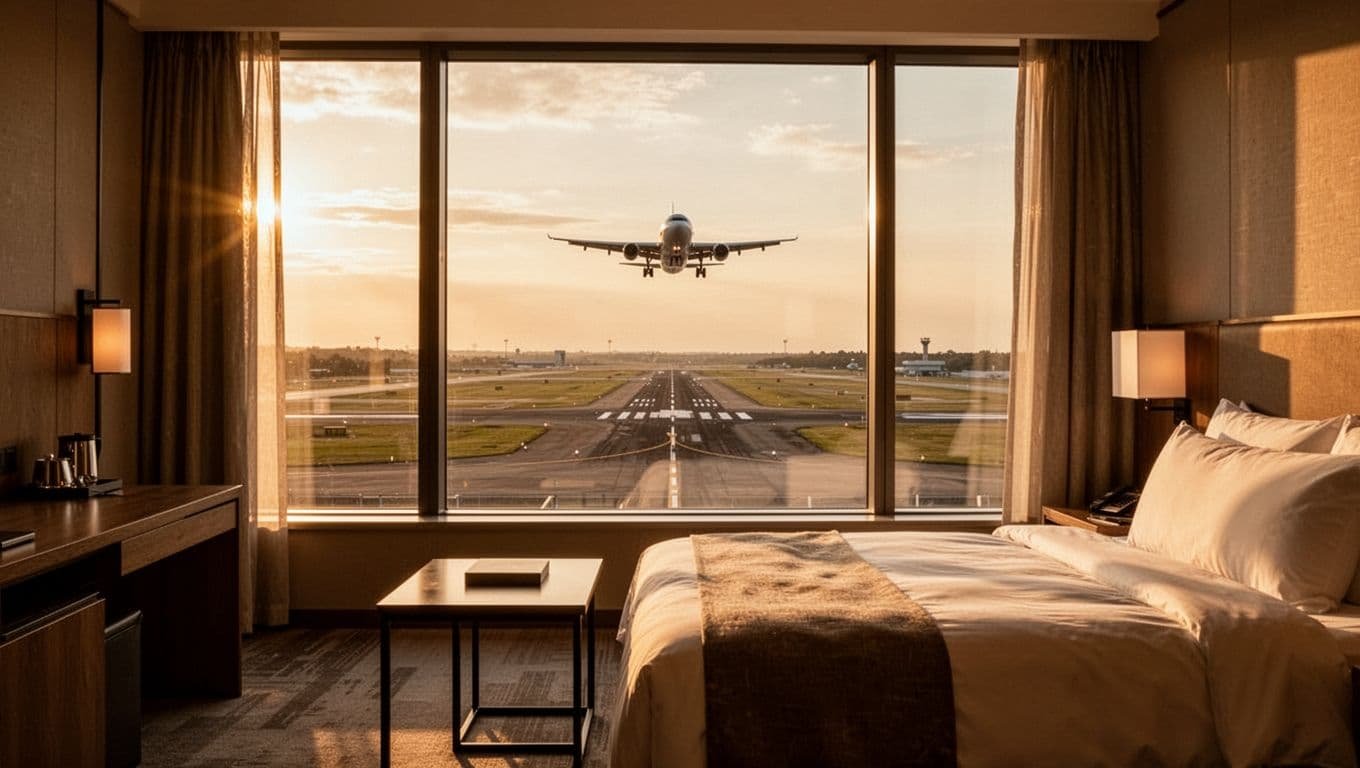
What matters most is position, not just proximity. We want to know whether the hotel sits along an arrival path, near active runways, or across from the side that usually handles the most visible action. We also need to watch for blockers. Cargo buildings, terminal concourses, hangars, parking garages, and even tree lines can turn a promising room into a partial view.
A quick map check usually tells us a lot. We look for:
- The hotel’s angle to the runways, not just the airport boundary.
- Large structures between the building and the airfield.
- Which side faces arrivals or departures most often.
- Whether the hotel is tucked behind terminals, where aircraft disappear from sight.
This is where many people miss the mark. A terminal hotel sounds like the obvious choice, and sometimes it is. But some terminal properties face inward toward roadways, gates, or terminal roofs. Meanwhile, an off-airport hotel a little farther out may have a cleaner sight line to the runway or final approach.
In other words, “inside the airport” does not always mean “best view.” We often get a better experience from a hotel that sits just outside the perimeter on the correct side. A room under an active arrival path can feel far more dramatic than one closer to the terminal but blocked by airport infrastructure.
If we’re serious about photos, this step matters even more. A hotel can be perfect for casual watching and still poor for clean visuals because of glass angle, heat haze, or terminal clutter. So before booking, we should picture what the view actually looks like, not what the hotel name suggests.
Use proven runway-view properties as your starting shortlist
After we narrow the airport and map position, we should start with hotels that already have a runway-view reputation. That doesn’t guarantee the perfect room, but it gives us a much stronger base than guessing from a booking site’s photo carousel.
A few well-known names keep coming up for good reason. At JFK, the TWA Hotel is one of the clearest examples, with runway-view rooms that are actively bookable in 2026. At Orlando, the Hyatt Regency Orlando International Airport is a long-time favorite because of its in-terminal location and airfield-facing vantage points. Houston Airport Marriott is another classic terminal option that often lands on avgeek shortlists. Around LAX, H Hotel is often mentioned alongside other airport-facing stays because the area offers strong aircraft interest if the room orientation is right.
Outside the U.S., the same pattern shows up at properties such as Renaissance London Heathrow and Crowne Plaza Changi Airport. In Atlanta, the Renaissance Concourse remains one of the best-known choices for travelers who want a hotel stay built around aircraft views. For a traveler-focused take on standout airport hotels, this list of favorite airport stays gives helpful context on why some properties attract aviation fans year after year.
Still, we should treat these hotels as a starting shortlist, not a guarantee. Even at proven properties, not every room has the same angle, floor height, or line of sight. One room may face a runway, another may face a parking area, and a third may only catch taxi traffic between buildings.
That difference is the next hurdle in How to Book a Hotel Room With a Runway View. Picking the right property gets us close, but the exact room is what turns a decent stay into the one we actually wanted.
Research the exact view before we book anything
This is where How to Book a Hotel Room With a Runway View stops being guesswork and starts working. A hotel can be perfect on paper and still give us a view of a parking loop, terminal roof, or a sliver of taxiway. If we want takeoffs, landings, and steady aircraft movement, we need to verify the room itself, not just the property.
The goal is simple. We want to confirm what we will actually see from the window, how wide the view is, and whether anything blocks it. A few extra minutes of research can save us from paying more for the wrong side of the building.
Read the room types carefully, because names can be misleading
Hotel room labels sound more precise than they really are. In practice, they often work like marketing shorthand, not aviation-grade detail. That is why we slow down and compare the official room descriptions line by line.
Some labels are more helpful than others:
- Runway view usually sounds best, but it still may mean a partial angle rather than a full runway panorama.
- Airport view can be much weaker. At many hotels, that means terminal roofs, service roads, ramps, or far-off taxiways.
- Tarmac view often focuses on apron activity, parked aircraft, or ground traffic, not departures and arrivals.
- City view is usually the wrong choice for spotting, even at an airport hotel.
- Executive room and premium view may describe floor level, room size, or lounge access, not the airfield angle.
That last point catches a lot of people. A premium room can cost more and still face the wrong side. An executive room may sit on a higher floor, which helps, but height alone does not fix bad orientation.
We also watch for vague wording. If the description says things like overlooks the airport area or offers aviation-inspired views, we do not assume runway action. Those phrases can cover almost anything. On the other hand, a listing that names the runway, airfield, apron, or landing traffic usually gives us more confidence.
A quick comparison table helps when several room names blur together:
| Room label | What it may mean | What we should verify |
|---|---|---|
| Runway view | Direct or partial runway sightline | Which runway, how much of it, and from which side |
| Airport view | Terminal area, roads, gates, or distant field | Whether aircraft movement is actually visible |
| Tarmac view | Apron, stands, parked jets, ground ops | Whether takeoffs or landings are in view |
| Premium view | Best non-specific outlook | If “best” means airport-facing or simply higher floor |
| Executive room | Better category, perks, or top floors | Whether the room faces the airfield at all |
| City view | Skyline or roadway side | Usually not useful for runway watching |
The main takeaway is simple: the room name is only a clue. The real answer sits in the detailed description, room photos, and, if possible, the exact side of the building. When two room types look close, we choose the one with the clearest official wording, even if the name sounds less exciting.
“Airport view” is not the same as “runway view,” and the difference can be the whole trip.
Check guest photos, reviews, and plane spotting sites
Once we narrow the room type, we look for proof from other travelers. Hotel marketing photos are polished, but guest photos tell us what the window really shows on a normal day. That matters because a runway can disappear fast behind glare, terminal clutter, or a bad angle.
We start with recent review photos on major booking platforms and travel review sites. Then we scan travel forums, YouTube room tours, and plane spotting hotel write-ups. A few well-known roundup pages, such as View From The Room’s airport hotel guide, can help us identify properties that already have a track record with aviation fans.
Reviews often hide the best clues in casual comments. Someone may mention that the “odd-numbered rooms faced the field,” that “higher floors cleared the terminal roof,” or that “the corner rooms had the widest view.” These small details are gold because they come from people who already stood at the same window we want.
Recent examples from spotter circles follow that pattern. Some properties are known for better views on one numbered side of the building, while others get strong recommendations for upper floors only. We treat those tips as helpful, not permanent, because hotels reassign categories, renovate floors, and sometimes change how they label rooms. Still, when the same detail appears in several reviews, it is usually worth trusting.
We also like niche reviews from avgeeks because they focus on the details regular travelers may ignore. A general guest may praise the silence and blackout curtains. A spotter will mention whether the aircraft are visible on short final, whether the glass is tinted, and whether the field view clears the hangars. That difference makes a big impact. For example, posts like this LAX plane spotting hotel review are useful because they discuss the actual viewing experience, not just the bed and breakfast.
Our quick process looks like this:
- Check the most recent guest photos first.
- Search the hotel name plus “runway view,” “airport view,” or “plane spotting.”
- Look for repeated mentions of room numbers, room stacks, or floor ranges.
- Favor comments that describe what was visible, not just whether the guest liked it.
- Give extra weight to recent reviews, because views can change after construction.
If we find a room-number tip, we save it right away. Even a note like “ask for rooms ending in 15” can make the booking desk request far more precise. Not every hotel will honor it, but a specific request beats “any room with a good view” every time.
Use maps and satellite view to judge sight lines for yourself
Reviews help, but maps let us verify the logic with our own eyes. We do not need to be airport experts to do this well. We just need a map, satellite view, and two or three minutes of focus.
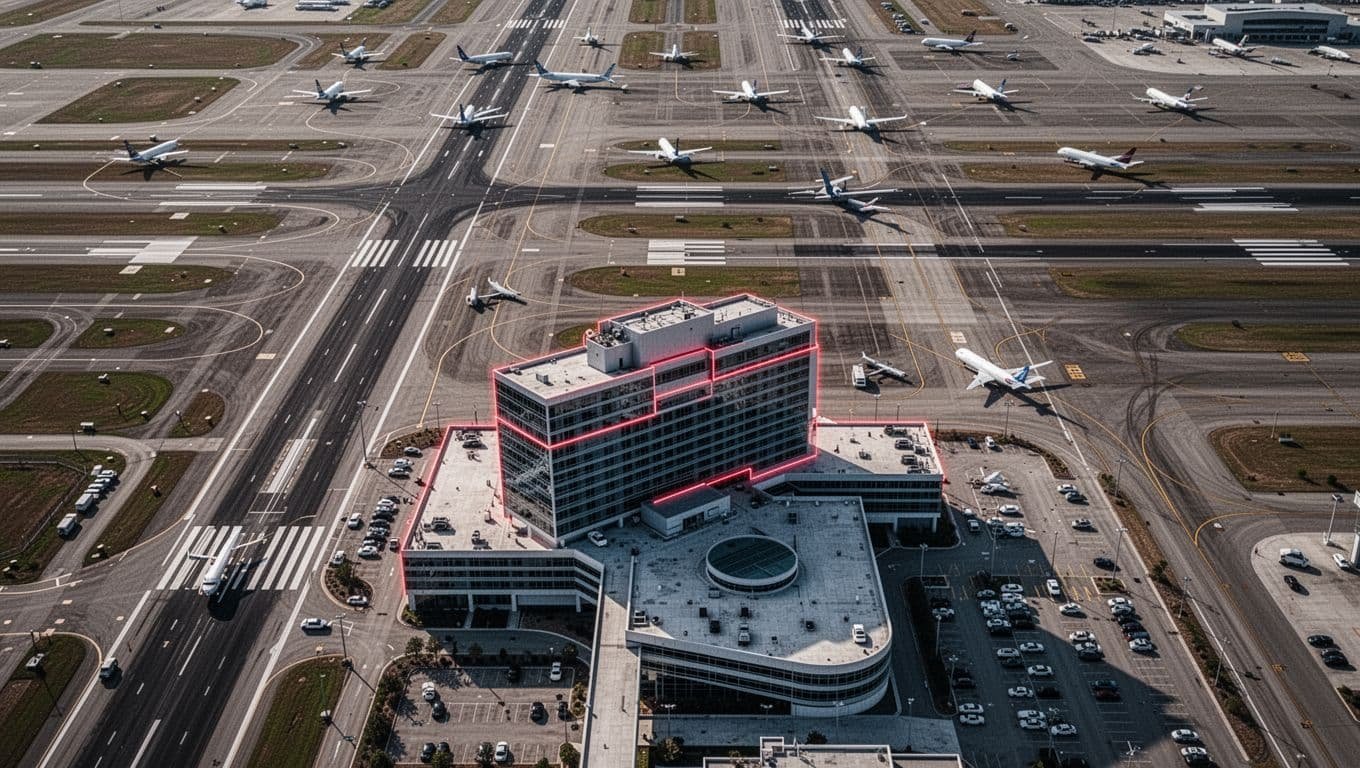
First, we find the hotel on the map. Next, we locate the runways, which are the long strips, not the curving taxiways. Then we look at which side of the hotel faces the runways most directly. If the building runs north to south, for example, only one long side may have a real chance at an airfield view.
After that, we look for blockers. This is the part people skip, and it is often where the bad rooms hide. Common visual blocks include:
- Terminal concourses and satellite gates
- Cargo ramps and freight buildings
- Hangars and maintenance areas
- Parking garages
- Tree lines and tall roadside signs
- Another hotel tower on the same lot
We also check distance. A room can face the runways and still feel far away if the hotel sits beyond roads, garages, and midfield structures. In contrast, a hotel a little farther from the terminal may have a cleaner, wider line of sight if nothing sits between the windows and the runway complex.
Here is the easiest way to judge it:
- Pin the hotel on the map.
- Identify the runways as the widest straight strips.
- Match the building face that points toward them.
- Scan for obstacles between that side and the airfield.
- Estimate angle and depth. A broad side-on view is usually better than a narrow corner peek.
This works especially well at airports with parallel runways. If the hotel faces those runways from the side, we may get long tracking views of taxiing, departures, and arrivals. If the hotel sits behind the terminal spine, we may only catch tails and brief movement gaps.
We do not need perfect technical knowledge here. We are just trying to answer a basic question: from this side of this building, can we actually see useful runway action? When the answer on the map matches the reviews and guest photos, we can book with much more confidence.
Book the room the smart way, then confirm it in writing
Once we’ve found a hotel with real sightlines, the next step is simple, but easy to mishandle. How to Book a Hotel Room With a Runway View often comes down to how we book, what we ask for, and whether we get that request in writing. A good hotel can still give us the wrong room if our request stays vague or never reaches the front desk.
Book direct when possible, so special room requests have a better chance
When we can, we book through the hotel itself. That usually gives us the clearest path to ask for a runway-facing room, a high floor, or the correct side of the building. It also makes it easier for staff to see the booking and attach a note that actually matters.
Third-party sites can still work, and sometimes the price is better. Still, they often show broader room labels, and that can blur the details we care about. A listing might say airport view when what we really need is a room that faces active movement, not the terminal roof or parking lot. As travel writers and advisors often note in pieces from Travel + Leisure on booking direct and The Points Guy’s guide to direct versus third-party bookings, direct bookings often give travelers more flexibility when they need changes or special handling.
That does not mean a direct booking guarantees the perfect room. It only means we remove one extra layer between us and the hotel. For a runway-view stay, that matters. We want the staff who assign rooms to see our request clearly, not as a buried note passed through another platform.
Call or email the hotel and ask for the exact view we want
A vague request gets vague results. If we say, “We’d love a nice view,” we may get a higher floor facing the road. Instead, we should ask for the exact setup we want.

A simple script works well:
“We’d like a high-floor room that faces the active runway side, ideally the best room type for plane spotting. If possible, are there certain room categories, room stacks, or room number ranges that usually have the clearest runway view?”
That one message does a lot. It tells the hotel we care about the view angle, not just floor level. It also gives staff a chance to share details they may know from experience, such as which side sees arrivals best or which rooms sit above lower rooflines.
We should also ask a few practical follow-ups:
- Whether a certain room type is more likely to face the runway
- Whether any known room-number range usually has the best angle
- Whether the windows are generally clean enough for spotting or photos
- Whether room noise is manageable, especially at night
- Whether photography through the glass is realistic, or if tint, glare, or sealed double panes make it tough
That last point matters more than many people expect. A room can have a strong view but still be poor for photos if the glass is dirty, tinted, or reflects the whole room back at us. Spotter guides like Airport Spotting’s hotel guide and directories such as Plane Spotting Hotels show how often the best rooms come down to exact room positions, not just the hotel name.
Get the request noted on the reservation, then reconfirm before arrival
After we speak with the hotel, we want the request added to the reservation notes. Then we want proof. A request is not the same as a guarantee, and hotels won’t always promise a specific room in advance. Still, a written note gives us something solid to point to later.
We like to ask for a short email that confirms the request was added. It doesn’t need to be fancy. We just want a reply that shows the hotel noted our preference for a runway-facing or airfield-facing room on the correct side.
Then we check again before arrival, usually 24 to 72 hours before check-in. That second contact matters because room blocks shift, maintenance happens, and upgrades or group bookings can move things around. A quick reconfirmation puts our request back in front of the team at the right time.
Timing also helps. If we arrive earlier in the day, the desk may have more room-choice flexibility. Late-night arrivals often get whatever is left, which is fine for sleep, but not ideal for a view. So if runway sightlines are the whole point of the stay, we try to check in early and politely restate the request at the desk. Sometimes that final ask is what turns a decent room into the right one.
Pick the room features that make runway watching better
When we figure out How to Book a Hotel Room With a Runway View, the hotel matters, but the room features often decide whether the stay feels great or disappointing. A strong view is not just about being near the airport. We also need the right floor, the right angle, glass we can actually see through, and a setup that lets us watch traffic without turning the night into a noise test.
Some rooms look promising on the booking page but fall apart in real life. Others sound ordinary, then surprise us with a clean sightline and a far better watching experience. That is why we look past the room name and focus on the features that change what we can see, hear, and enjoy.
Higher floors usually win, but angle matters just as much
In most cases, higher floors give us a wider field of view. We can usually see over roadways, parking lots, terminal roofs, and service buildings that block lower rooms. That extra height also helps when we want to follow an arrival longer or watch aircraft taxi across a broader slice of the field.
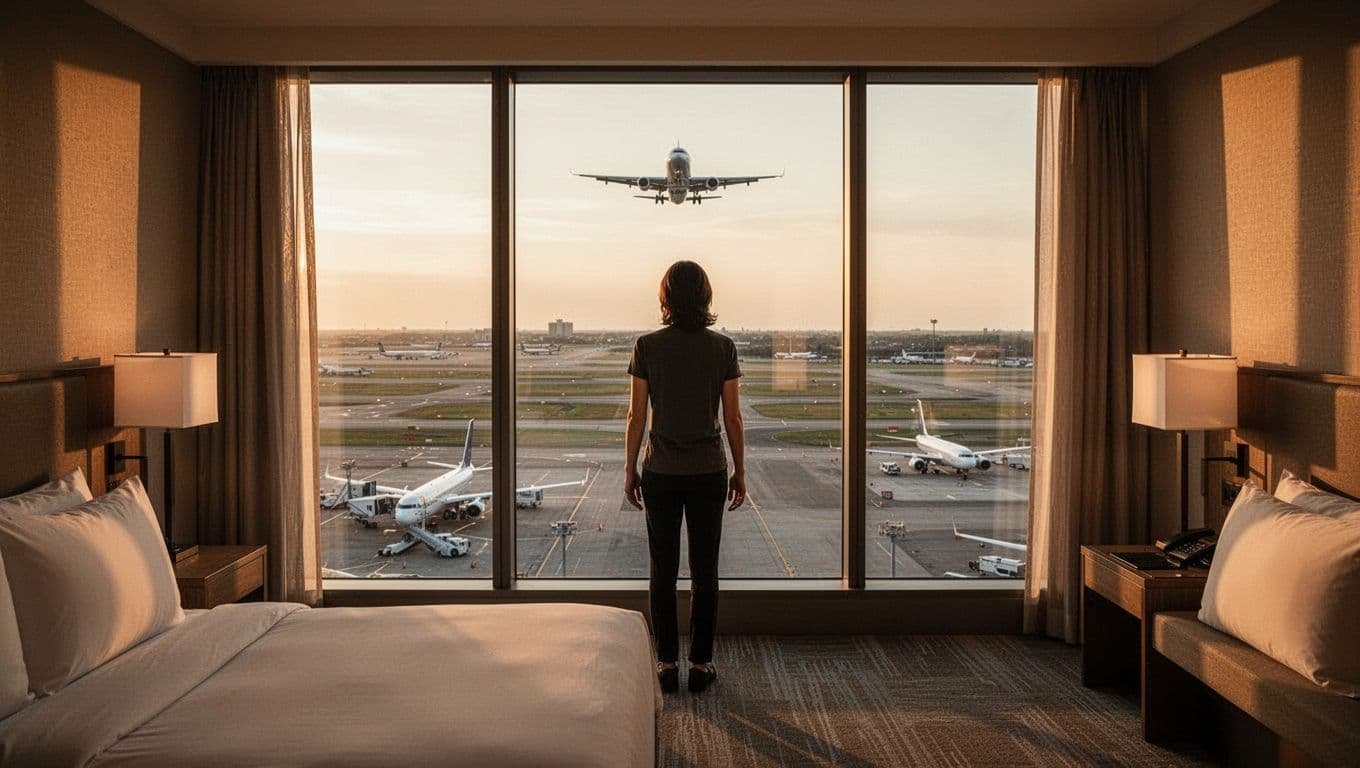
Still, height does not fix a bad angle. A top-floor room on the wrong side of the building can leave us staring at a parking deck or terminal wall. We would rather take a mid-floor room with a direct runway line than a penthouse that faces away from the action.
This is where the building layout matters. A hotel may sit close to the airport, but only one wing may have the good sightline. Corner rooms can sometimes help because they open up two directions at once. On the other hand, some corner rooms lose the best straight-on view and only catch brief movement.
Lower rooms are not always a lost cause, either. If a room directly faces final approach or a clear taxiway line, we may still get a very satisfying view. Watching aircraft roll past nose-on can be better than seeing a distant runway from much higher up. That is especially true at airports where arrivals pass close to the hotel or where taxi traffic stays visible for long stretches.
A simple rule works well here:
- Higher floors usually help with breadth
- Better angles usually help with actual action
- The best rooms give us both
Good windows, sound control, and room layout matter more than people expect
A runway-view room lives or dies by the window. We want large, clean glass with as little tint as possible. Heavy tint can flatten the colors, hide detail, and make dusk watching less enjoyable. Glare is another common problem, especially when lights inside the room bounce back at us like a mirror.
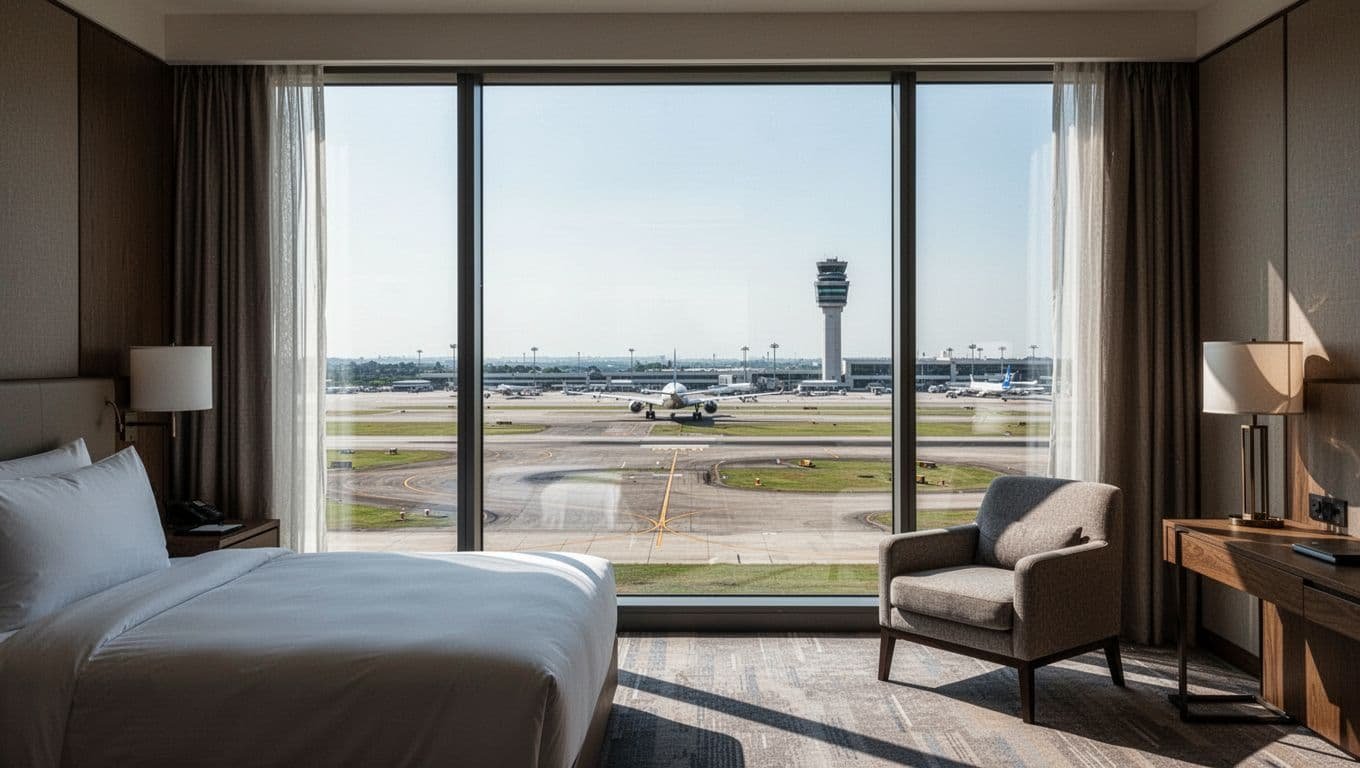
The best setup feels simple. We want a chair near the window, space to stand comfortably, and a bed that does not force us to watch from an awkward angle. If the desk, lamp, or TV throws reflections onto the glass, even a strong runway view can become frustrating at night. In other words, a good aviation room should feel like a quiet lookout, not a bright box with a distant airport beyond it.
Sound control matters just as much. We may love aircraft noise for an hour, then want real sleep at midnight. Great airport hotels manage both. Some properties are especially well known for keeping rooms quiet while still offering airfield views. For example, Hilton Chicago O’Hare Airport is often praised for runway-view rooms with strong sound isolation, and reports on places like Westin Denver Airport show why soundproofing can make an airport stay much easier.
The ideal runway-view room lets us enjoy the airport when we want it, then shut it out when we don’t.
If we have to choose, we usually take better windows and quieter sleep over a slightly closer view. A room that is pleasant for six hours is good. A room that is pleasant all night is the one we remember.
Balconies, lounges, rooftops, and pools can beat the room itself
Sometimes the best runway watching does not happen inside the room at all. A hotel can have decent rooms, yet still offer a much better experience from a rooftop, lounge, terrace, or pool deck. These shared spaces often give us a wider angle, less glare, and a chance to watch without pressing up against sealed glass.
That is why we always check the full property, not just the room photos. A rooftop bar or outdoor deck can turn a fair airport hotel into a great spotting stay. The view often feels more open, and photos usually improve because we are not shooting through tinted windows or reflections.
A few airport properties show how much these spaces can matter. The TWA Hotel stands out because its rooftop setting adds another layer to the stay, not just another amenity. In the same way, 2026 hotel roundups and traveler reports continue to point to rooftop and lounge concepts at properties near major airports, including hotels around LAX and Atlanta, where public viewing areas can outshine the room itself. Even hotels recognized more broadly, such as Grand Hyatt at SFO, remind us that the best airport stays are often about the full viewing experience, not only the bed behind the window.
These spaces help most when:
- the room windows are tinted or reflective
- the best sightline sits above the guest floors
- we want a more social, relaxed way to watch traffic
- we care about photos as much as the stay itself
Pools can work surprisingly well too, especially when they face the field. A runway in the distance from a quiet deck chair can feel better than a technically better room view. We still book the best room we can, of course, but we never ignore the hotel’s public spaces. Sometimes the real star of the stay is one floor up, outside, and open to the sky.
Avoid the mistakes that usually lead to a bad airport view
Even when we get the hotel, floor, and room type mostly right, a few small mistakes can still ruin the stay. This is the part of How to Book a Hotel Room With a Runway View that saves us from the most common letdowns, because a room can look promising on paper and still miss the action in real life.
For plane spotters, the gap between a good room and a disappointing one is often simple: bad assumptions, vague check-in language, or poor timing. If we avoid those three traps, our odds of getting the view we actually want go up fast.
Don’t assume an airport hotel automatically means a runway view
An airport hotel is not the same thing as a runway-view hotel. That’s the mistake that catches a lot of people, especially at large airports with terminals, garages, office buildings, and access roads packed around the field.
Many airport-facing rooms show airport property, not active runway action. From the window, we might get a parking deck, a terminal roof, a service road, or a row of office buildings with a sliver of apron in the distance. Technically, that still counts as an airport view. For spotting, it can feel like paying for a concert and getting a seat behind a pillar.
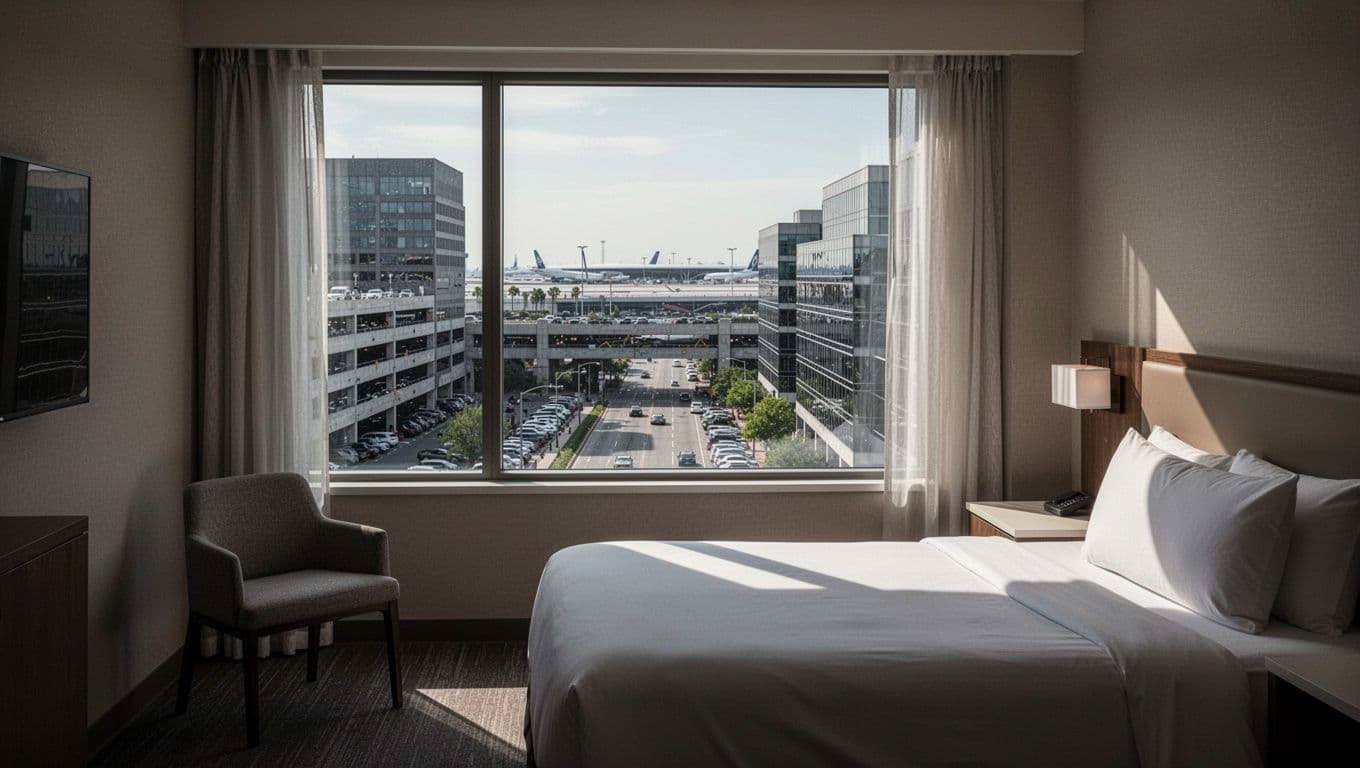
This matters even more at hotels attached to terminals. Those properties sound ideal, but some face inward toward drop-off lanes, concourses, or enclosed courtyards. Meanwhile, a hotel a bit farther away may have the cleaner view because it sits on the right side of the airport.
So we should treat the hotel name as a clue, not proof. Reviews from aviation-focused sources, such as Key Aero’s airport hotel spotting guide, help show how much room position changes the experience. The main lesson is simple: closeness helps, but orientation wins.
Don’t settle for vague promises at check-in
Check-in is often the last point where we can fix a weak room assignment. That’s why we shouldn’t accept soft phrases like airport side, partial airport view, or good view of the field without asking what they actually mean.
Those labels can hide a lot. “Airport side” might mean terminal buildings. “Partial view” might mean a tiny slice of taxiway between structures. If we want real movement, we should politely ask whether the room shows:
- active runways
- taxiways with regular movement
- apron traffic only
- terminal buildings and ramps, but no runway
That one follow-up can save the whole stay.
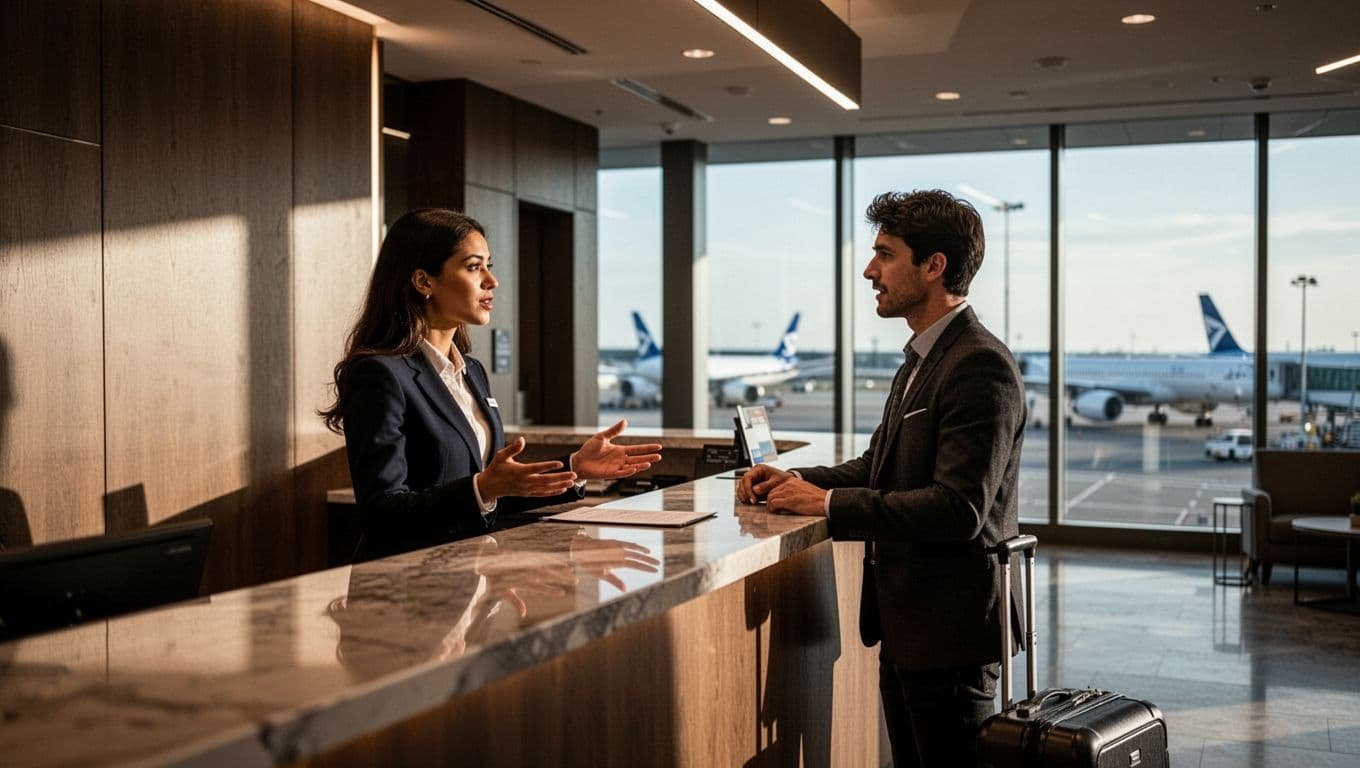
We usually keep it direct and friendly: “Can you tell us if this room actually faces an active runway or taxiway, or does it mainly look toward the terminal?” Staff can often answer clearly when we ask clearly.
If the answer sounds weak, it’s much easier to switch rooms before we unpack, set up camera gear, or settle in. Once bags are open and time passes, options shrink. A quick room check right after entry is worth the effort. Open the curtain, confirm the line of sight, and decide fast.
This is also where specific language helps more than enthusiasm. We don’t ask for “the best room.” We ask for the room with the clearest view of active aircraft movement. That gives the front desk something useful to work with.
If the staff description is vague, the view usually will be too.
Don’t forget timing, weather, and runway changes
Even the perfect room cannot force traffic onto the runway in front of us. Airports change runway use based on wind, traffic flow, and operations, so a great-looking room can still have a quiet window of time.
That’s normal. Some days the active runway shifts away from our side of the hotel. At other times, the field is busy, but the peak bank happens earlier or later than we expected. Weather can change things too. Low clouds, haze, rain, and backlighting can flatten the view or slow the kind of action we hoped to photograph.
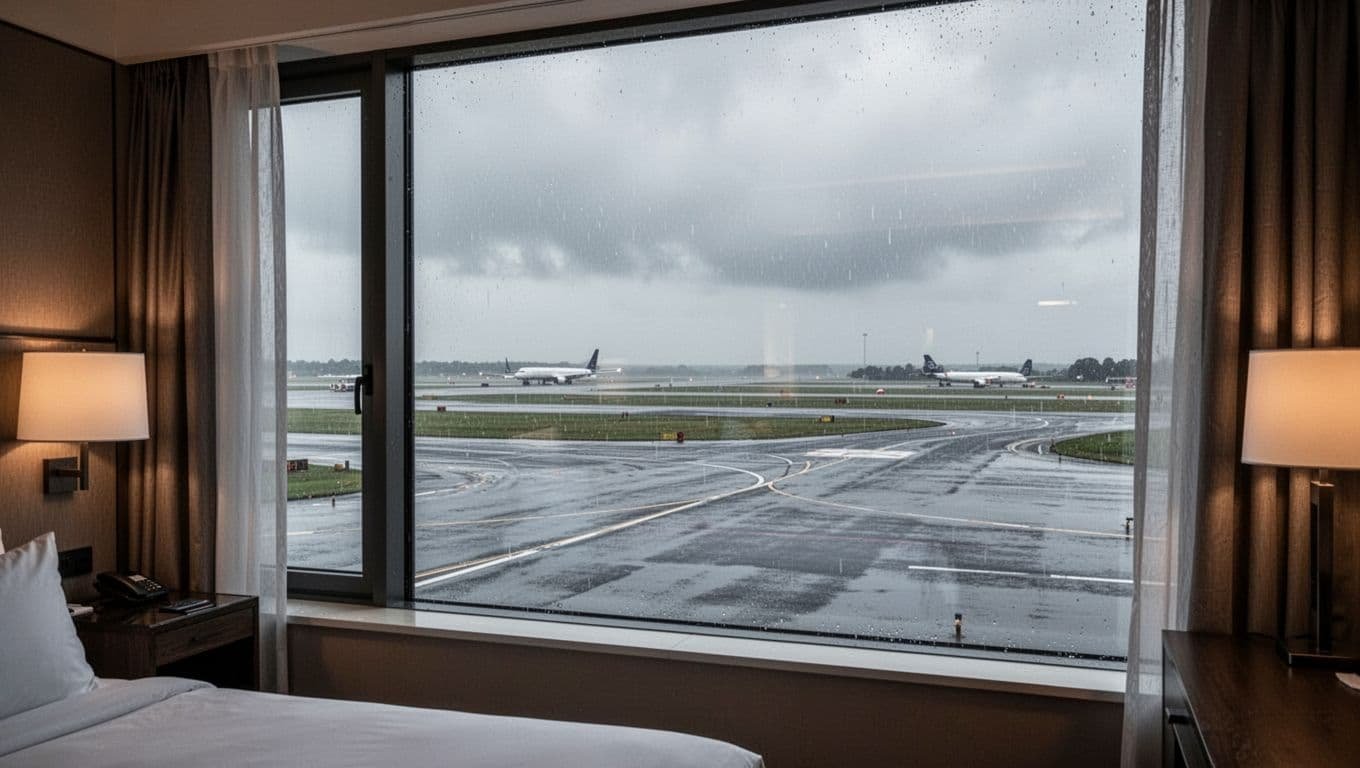
Because of that, we need realistic expectations. A runway-view room is still worth it during a slow stretch, but it may not line up with golden hour, heavy departure banks, or the exact sequence we pictured. For spotting culture and the way enthusiasts plan around traffic and viewing angles, Condé Nast Traveler’s look at plane spotting captures that mindset well.
A simple approach helps:
- Check likely busy periods before arrival.
- Expect runway use to change.
- Treat weather and light as part of the experience, not a broken plan.
In other words, the room gives us the opportunity, not a guaranteed show. When we remember that, we make better booking choices and enjoy the stay more.
Conclusion
How to Book a Hotel Room With a Runway View comes down to one thing: proof beats guesswork. When we research the sightline, contact the hotel directly, and confirm the request before arrival, we give ourselves a far better shot at the room we actually want.
For aviation fans, the strongest takeaway is simple. The best runway-view stays come from maps, recent guest evidence, and clear written notes on the reservation, not luck at check-in. That’s what turns an airport hotel into a real spotting base instead of a room overlooking a parking deck.
Before the next trip, we should save room-number tips, floor notes, and view details that worked well. Over time, that gives us a trusted shortlist of airport hotels we can book again with confidence, and that makes every future spotting stay easier.
Pingback: Best Budget Plane Spotting Hotels for Aviation Enthusiasts 2026
Pingback: Best Airport Hotels With Runway Views: Our 2026 Ultimate List
Pingback: Best Plane Spotting Hotels in the World, Top Airport View Stays 2026